|
Zoology in the Middle East
|
|
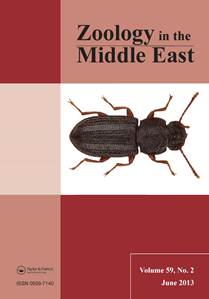
Starting with Volumer 59 (2013), Zoology in the Middle East will be published by the British publisher Taylor & Francis. Taylor & Francis is a highly respected publisher with two centuries of experience in scientific publishing (e.g. “Journal of Natural History”), and a strong commitment to further strengthen and promote Zoology in the Middle East. The editorial office will remain unchanged. Please visit the journal’s new web site at http://www.tandfonline.com/toc/tzme20/current#.UZ8Mkp3wCig
The Middle East at its location at the intersection of three zoogeographic regions endows a vast landscape with a striking diversity of habitats and fauna and flora with many endemic species. Zoology in the Middle East is the only scientific journal covering the whole range of zoology in this unique region of the world and helps further the understanding of the Middle East as a zoogeographical unit. The journal aims at improving the interchange of knowledge and ideas between specialists on different subjects and taxa.
Zoology in the Middle East publishes original papers on ecology, zoogeography, animal biology, biodiversity, faunistics, systematics, and taxonomy of the Middle East. Single issues of the journal may be dedicated to certain topics, animal groups or regions. 968 authors from 55 countries (click here for list) have published their scientific results in Zoology in the Middle East. The journal is thus a unique information source on Middle East wildlife; the first 53 volumes and three Special Issues comprise over 7000 printed pages. The presence of the journal in the internet is continuously growing and a Google Internet Search on Zoology in the Middle East gives currently (July 2011) almost 271,000 results, which shows that the journal ranks very high compared with similar journals.
Zoology in the Middle East has found place in the elite Science Citation Index Expanded (SCIE), which comprises a selection of the world's leading scholarly science and technical journals from more than 150 disciplines, and forms the basis for calculating the impact factor (IP). It is a refereed journal with an Advisory Board whose members come from twelve different countries.
ISSN 0939-7140
. . . . . . . . . . . . . . . . . . . . . . . . . . . . . . . . . . . . . . . . . . . . . . . . . . . . . . . .
EditorsDr Max Kasparek (click here)Consultant Natural Resources Management, Heidelberg Associate EditorDr Adrian C. PontUniversity Museum of Natural History, Oxford Advisory Board MembersProf. Dr Zuhair S. AmrJordan University of Science & Technology, Irbid Prof. Dr Wolfgang BöhmeMuseum Alexander König, Bonn Dr Brian W. CoadCanadian Museum of Nature, Ottawa Prof. Dr Ali DemirsoyHacettepe University, Ankara Dr Sherif Baha El DinEgyptian Environment Affairs Agency, Cairo Prof. Dr Victor FetMarshall University, Huntington (USA) Prof. Dr Uwe FritzSenckenberg Collections, Dresden Dr Francis GilbertNottingham University, Nottingham (U.K.) Prof. Dr Henri DumontGhent University, Ghent Dr Bahram H. KiabiShaheed Beheshti University, Tehran Prof. Dr Ragnar KinzelbachUniversity of Rostock, Germany Dr Boris KryštufekUniversity of Primorska, Koper, Slovenia Dr Fareed KruppQatar Natural History Museum, Doha Dr Wilson R. LourençoMuséum National d'Histoire Naturelle, Paris Prof. Dr Abdul Karim NasherSana’a University, Yemen Dr Tomáš PavlíčekUniversity of Haifa, Israel Dr Lina RifaiIndiana University Kokomo Dr Çağan H. ŞekercioğluUniversity of Utah, U.S.A. |
|
Table of Contents Complete Table of Contents for vols. 1–57 (click here)
List of Authors All authors who published in vols. 1–48 (click here)
Indexing In addition to the Science Citation Index (SCIE), Zoology in the Middle East is included in the BioSciences Information Service (BIOSIS) of Biological Abstracts and Zoological Record, ISI Database, CAB Abstracts, The Ibis, Ecological Abstracts, GEOBASE, Wildlife Review Abstracts, Fisheries Review, NISC’s FISHLIT (Fish and Fisheries Worldwide), Aquatic Biology, Aquaculture and Fisheries Resources, Cambridge Scientific Abstracts/ Entomology Abstracts, VINITI Abstracts Journal (Referativnyi Zhurnal), and other review organs. Taxonomy Original descriptions of new scientific names for animals representing nomenclatural acts as governed by the ICZN Code of Nomenclature are registered in the Index to Organism Names (ION) published by Thomson Reuters, and are assigned with a Life Sciences Identifier (LSID). This information is also provided to ZooBank, the Global Names Index and other name repositories.
E-mail Alert Service If you would like to find out more about the content of Zoology in the Middle East, you can register to receive regularly tables of contents through our E-mail Alerting Service: add my name to your mailing list
Supplementary publications (selection) ---------------- Edited by T. Pavlicek,P. Cardet, Cs. Csuzdi, R.-C. Le Bayon & J.-MN. Gobat (2012, ISBN 9783-925064-68-5, 188 pages, many graphs, maps and figures, EURO 28.00)
Biodiversity Conservation in the Arabian Peninsula Edited by Mike Knight, David Mallon, Philip Seddon (2011, ISBN 9783-925064-67-8, 208 pages, many graphs, coloured and b/w photographs, maps and figures, EURO 28.00)
The Darkling Beetles of the Sinai Peninsula
© by Kasparek Verlag, Heidelberg.
|
Highlights – Files free to download (PDF)
Selection of articles which are available to dowload free of charge:
The full set of articles published in the Special Issue on Biodiversity Conservation in the Arabian Peninsula (supplementum 3) is available for free download. Please click here.
(from Vol. 55, 2012, 1645kB)
A new freshwater amphipod species, Gammarus katagani sp. nov., from Turkey (Amphipoda: Gammaridae)
(from vol. 55, 2012, 1030kB)
New and additional records for the ant fauna from Iran (Hymenoptera: Formicidae)
(from Vol. 55, 2012, 5045kB)
The hunter-flies of Armenia. II. The genus Lispe Latreille, 1796 (Insecta: Diptera: Muscidae)
(from Vol. 55, 2012, 273k)
New records of freshwater and land molluscs from Lebanon
(from vol. 54, 2011, 425kB)
(from vol. 54, 2011, 298k)
The molluscan bio-fouling community on the Red Sea pearl oyster beds
(from vol. 51, 2011, 134 kB)
Assessment of the origin of a Loggerhead Turtle, Caretta
caretta, found in Kuwaiti waters, using mitochondrial DNA (from vol. 49, 2010, 132 kB)
On the status and distribution of the Striped Hyaena, Hyaena hyaena, in Turkey (from vol. 33, 2004) (280 kB)
On the diet of the Eagle Owl, Bubo bubo, in Syria (from vol. 33, 2004) (71 kB)
Population status and conservation of marine turtles at El-Mansuri, Lebanon (from Vol. 27, 2002) (224 kB)
On the current status and distribution of the Jungle Cat, Felis chaus, in Jordan (Mammalia: Carnivora) (from vol. 30, 2003) (350 kB)
The endemic Iranian Cave-fish, Iranocypris typhlops: two taxa or two forms based on the mental disc? (from vol. 44, 2008) (328 kB)
On the biology of Acanthalburnus urmianus, an endemic fish of Iran
(Short Communication, from vol. 43, 2008)
A preliminary list of the Fanniidae and Muscidae (Diptera) of Armenia
(from vol. 36, 2005) (360 kB)
Population status of the Persian Leopard (Panthera pardus saxicolor Pocock, 1927) in Iran
(from vol. 26, 2002) (1700 kB)
The natural areas and landscape of Iran: an overview
(from Vol. 26, 2002) (149 kB)
Organisations and institutions working on marine turtles in the Mediterranean
(from Vol. 24, 2001) (211 kB)
Resources available to individuals and organisations involved with marine turtle research and conservation in the Mediterranean (from vol. 24, 2001) (144 kB)