|
Zoology in the
|
|
|
published by Kasparek Verlag Mönchhofstr. 16, 69120 Heidelberg Fax 06221 / 471858, E-mail: Kasparek@t-online.de |

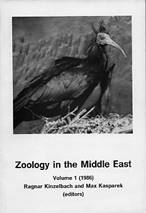
Volume 1, 1986
Volume 1 (1986) consists of “short
communications” without abstracts.
Preface to the first volume of the journal:
Preface
For zoologists, and not only for them, the Middle East
is a very special region. Its geographic situation is characterised by two contrasting
features: on the one hand this region of approximately 8 million square
kilometers – slightly smaller than Europe – is nearly an island, surrounded by
former or still existing seas; on the other hand it is a transitional area
between three continents. It also contains a very rieh variety of habitats,
some of them unique in the worid. All this is reflected in an outstanding
fauna, resulting from the isolation, ecological variety, and faunal exchange
cited.
Thus the fauna of the Middle East may be used as a
model in many respects, a model which is surprisingly little known despite the
efforts of hundreds of zoologists and interested laymen of all periods since
antiquity. Our aim, in the long term, therefore, is to improve the situation
both regarding reliable information on the facts and for scientific causal
analysis.
In so doing, we are faced with a special problem which
we hope to solve with this booklet, which may hopefully develop into a
periodical.
The problem is that short contributions in “classical”
zoology, although of scientific interest and of a high standard of writing, are
at times not printed due to the lack of a suitable journal. The traditional
zoology periodicals are usually not interested. Publication in local journals
in Middle East countries in local languages does not really amount to
“publication” in the strict sense of the word. Publication, on the other hand,
in local journals of Europe or North America, again makes the results
inaccessible, especially for our Middle East colleagues.
We are therefore trying to establish an international
forum. It is aimed at short communications on morphology, zoogeography,
faunistics, systematics, animal biology, and ecology, serving both orientais
and occidentals. To keep a certain standard, the contributions are refereed.
Like this first volume, the following are also
intended to cover all animal taxa. This time vertebrates dominate; in the
future we hope to present a well balanced programme. Frequency and volume of
subsequent editions depend solely on the interest and participation of authors
as well as readers. We trust in both.
The
editors
Heidelberg
and Mainz, November 5th, 1986
Abstracts Volume 2, 1988
For ordering articles per email please click here (price
per article EUR 10.00 plus postage)
Zoology in the Middle East 2, 1989: 8-11.
Egyptian Mongoose, Herpestes
ichneumon, in southem Turkey
by Cecilia
A. W. Bosman and Arnoud B. van den Berg
Abstract: Foot-prints and direct observations showed that the Egyptian Mongoose
is relatively common in the Çukurova region of southern Turkey. Droppings
contained approx. 65 birds.
Kurzfassung:
Sichtbeobachtungen und Spuren zeigten, daß die Manguste im Çukurova-Gebiet der
Südtürkei relativ häufig ist. Im Kot ließen sich zu 65 Vögel nachweisen.
Zoology in the Middle East 2, 1989: 8-11.
On the occurrence of the Weasel, Mustela nivalis, in
Turkey
by Max
Kasparek
Abstract: It was shown that the Weasel is distributed over the whole of
Anatolia. The species’ considerable size, the occasional occurrence of a white winter coat and the existence of two
types of Weasels (nivalis type and minuta type) in Turkey have often lead
to the wrong assumption that the Stoat (M.
erminea) also occurs in Turkey.
Kurzfassung:
Das Mauswiesel ist, wie eine Zusammenstellung publizierter und unpublizierter
Nachweise zeigt, über die gesamte Türkei verbreitet. Die beträchtliche Größe,
das gelegentliche Auftreten von weißem Winterfell und die Existenz von zwei
Morphen (nivalis-Typ und minuta-Typ) hat oft zu der fälschlichen
Annahme geführt, auch das Hermelin, Mustela
erminea, würde in der Türkei
vorkommen.
Zoology in the Middle East 2, 1989: 12-15.
Grey-headed Woodpecker, Picus
canus, in north-eastern Turkey
by Arnoud
B. van den Berg
Abstract: A new record of the Grey-headed Woodpecker in north-eastern Turkey
shows, together with published results, that the species apparently is
distributed in low density over the whole Black Sea region of Turkey.
Kurzfassung:
Ein Neunachweis des Grauspechtes in der Nordosttürkei zeigt zusammen mit
bereits publizierten Befunden, daß diese Art in sehr geringer Dichte offenbar
in der ganzen türkischen Schwarzmeerregion vorkommt.
Zoology in the Middle East 2, 1989: 16-18.
Paddyfield Warbier, Acrocephalus
agricola, at Van Gölü, eastem Turkey
by Arnoud
B. van den Berg and Cecilia A. W. Bosman
Abstract: A Paddyfield Warbler was mist-netted at Van in eastern Anatolia on
8.5.1987. This is the second record for Turkey.
Kurzfassung:
Am 8.5.1987 wurde bei Van in Ostanatolien ein Feldrohrsänger gefangen. Dies ist
der zweite Nachweis für die Türkei.
Zoology in the Middle East 2, 1989: 19-25.
The White-breasted Kingfisher, Halcyon
smyrnensis, in Turkey: on the
occurrence of an endangered species
by Vincent
van den Berk and Max Kasparek
Abstract: The size of the Turkish population of the White-breasted Kingfisher is
estimated to be about 100-150 pairs of which approx. 75 are concentrated in
five localities. This makes the species vulnerable. A
distribution map is given.
Kurzfassung:
Der türkische Brutbestand des Braunliestes wird auf etwa 100-150 Paare
geschätzt, wobei etwa 75 auf nur fünf Gebiete konzentriert sind und wodurch der
Bestand leicht gefährdet werden kann. Die Verbreitung wurde kartographisch
dargestellt.
Zoology in the Middle East 2, 1989: 26-30.
Species assemblages and distribution patterns of swallows and
swifts in the Near and Middle East
by Einhard
Bezzel
Abstract: Even in areas with a rich insect life inhabited by several species of
swallows and swifts, different preferences and species assemblages during
aerial hunting can be observed. Geographical differences in distribution and
abundance, different habitat preferences, time of season and day as well as
different range of hunting flights will influence local species assemblages and
coexistence during aerial hunting.
Kurzfassung:
Auch in Gebieten mit relativ vielen Schwalben- und Seglerarten und reichem
Insektenleben lassen sich unterschiedliche Präferenzen und daher
Artenkombinationen bei der Luftjagd beobachten. Verschiedene Faktoren können
die Verteilung bzw. Koexistenz von Luftjägern in Raum und Zeit bestimmen:
Geographische Unterschiede der Verbreitung und Häufigkeit, unterschiedliche
Habitatpräferenzen, Jagdzeiten und -techniken sowie Reichweite der Jagdflüge.
In Gebieten mit bis zu neun brütenden Arten konnten in fast zwei Drittel der
Kontrollen nur je eine Art gleichzeitig auf der Jagd beobachtet werden.
Zoology in the Middle East 2, 1989: 3138.
The Demoiselle Crane, Anthropoides
virgo, in Turkey: distribution and
population of a highly endangered species
by Max
Kasparek
Abstract: The Demoiselle Crane is one of the rarest bird species of Turkey.
20-30 pairs breed at a few sites in Eastern Anatolia. In contrast to the major
part of its ranges, it is confined to wetlands. Compared to Cyprus, the number
of migrants is relatively low, which might be explained by a low observation
activity during migration seasons.
Kurzfassung:
Der Jungfernkranich ist eine der seltensten Vogelarten der Türkei. Er kommt in
etwa 20-30 Paaren an wenigen Stellen in Ostanatolien vor. Im Gegensatz zum
größten Teil seines Areals ist er in der Türkei ein Feuchtgebietsbrüter. Im
Vergleich zu Zypern sind die Durchzugszahlen in der Türkei äußerst gering, was
mit einer geringen Beobachtungsaktivität zu den Zugzeiten erklärt wird.
Zoology in the Middle East 2, 1989: 39-42.
The Eregli Marshes: a new nesting site for the Greater Flamingo, Phoenicopterus ruber, in Turkey
by Aygün
Kılıç
Abstract: 35-40 old Flamingo nests were found in the Eregli Marshes in 1987.
Successfui breeding probably did not take place. A review of Flamingo breeding
in Turkey is given.
Kurzfassung:
1987 wurden in den Eregli-Sümpfen 35-40 alte Flamingo-Nester gefunden. Der
Brutversuch war jedoch wahrscheinlich nicht erfolgreich. Die Angaben über Brut
des Flamingos in der Türkei werden zusammengestellt.
Zoology in the Middle East 2, 1989: 43-45.
The Trumpeter Finch, Bucanetes
githagineus, in Turkey
by Hubert
Krieger
Abstract: A Trumpeter Finch was recorded on Nemrud Mountain in Eastern Anatolia
on 17.8.1987. Together with some other unpublished records, this indicates
breeding at a few sites in eastern Turkey.
Kurzfassung:
Am 17.8.1987 wurde am Nemrud-Krater in Ostanatolien ein Wüstengimpel
festgestellt. Zusammen mit anderen unveröffentlichten Nachweisen zeigt dies das
wahrscheinliche Brüten an einigen Stellen der Ost-Türkei.
Zoology in the Middle East 2, 1989: 46-48.
On the present situation of vultures in Bulgaria: a review
byRolf
Uhlig
Abstract: A review of the literature indicated that about 100 pairs of Egyptian
Vultures, less than five pairs each of Griffon Vultures and Black Vultures and
no more Lammergeiers breed in Bulgaria.
Kurzfassung:
Gemäß einer Literaturübersicht kommen in Bulgarien etwa 100 Paare Schmutzgeier,
weniger als 5 Paare Gänse- und Mönchsgeier und keine Bartgeier mehr vor.
Zoology in the Middle East 2, 1989: 49-51.
Additional records of the Ring-necked Parakeet, Psittacula krameri, from Egypt and the Middle East
by Jörg
Wittenberg
Abstract: Additional new records and references from the literature are given
for the Ring-necked Parakeet, Psittacula
krameri, in Egypt. Jordan, Israel and
Syria. The species only succeeds in surviving in areas where there is little
pressure from hunting, for example the city area of Cairo and several
localities in Israel.
Kurzfassung:
Weitere neue Daten und Literatur-Hinweise zum Vorkommen des Halsbandsittichs, Psittacula krameri, in Ägypten, Jordanien, Israel und Syrien. Eine
erfolgreiche Ansiedlung ist nur in Gebieten mit geringerem Verfolgungsdruck
gelungen, z.B. im Stadtbereich von Kairo und an einigen Stellen in Israel.
Zoology in the Middle East 2, 1989: 52-56.
On the occurrence and status of the Chameleon, Chamaeleo chamaeleon, in Turkey
by Ibrahim
Baran, Max Kasparek and Mehmet Öz
Abstract: The main distribution area of the Chameleon in Turkey is the Aegean
and the Mediterranean regions, however, records are also available frorn the
Marmara region and from south-east Anatolia.
Kurzfassung:
Das Hauptverbreitungsgebiet des Chamäleons in der Türkei ist die Ägäis und die
Mittelmeerregion, doch liegen auch aus dem Marmaragebiet und aus
Südost-Anatolien Nachweise vor.
Zoology in the Middle East 2, 1989: 57-62.
On the distribution of the Slow Worm, Anguis fragilis, and the
European Glass Lizard, Ophisaurus apodus, in Turkey
by Ibrahim
Baran, Max Kasparek and Mehmet Öz
Abstract: The two subspecies of Ophisaurus
apodus represent different ecotypes: thracicus is a coastal type, which
occurs in Turkey along all coasts (but only local along the Black Sea coast),
whereas nominale apodus is an inland
type which is found in Turkey only in the extreme east. Anguis fragilis is confined
to areas in which the monthly mean precipitation is above 20 mm.
Kurzfassung:
Die beiden Subspecies des Scheltopusik, Ophisaurus
apodus, repräsentieren verschiedene
Ökotypen: thracicus ist ein
Küstenbewohner, der in der Türkei entlang aller Küsten (jedoch nur lokal an der
Schwarzmeerküste) vorkommt; die Nominatform hingegen kommt nur im Binnenland
vor und ist in der Türkei auf ein kleines Gebiet in Ostanatolien beschränkt.
Die Blindschleiche, Anguis fragilis, ist auf Gebiete beschränkt, in
denen die monatliche Niederschlagssumme im Mittel über 20 mm liegt.
Zoology in the Middle East 2, 1989: 63-67.
The remains of a fossil Soft-shelled Turtle (Trionyx) from the Bayraktepe area (Turkey)
by Vahdet
Tuna
Abstract: The remains ofthe pectoral girdle (scapulocoracoid) and carapace of Trionyx sp. which were found in the
Upper Miocene Sediments of Bayraktepe are described and discussed.
Kurzfassung:
Reste des Schultergürtels (Scapulocoracoid) und des Rückenpanzers (Carapax)
einer fossilen Weichschildkröte Trionyx
sp. aus dem Obermiozän von Bayraktepe werden beschrieben und eingeordnet.
Zoology in the Middle East 2, 1989: 68-71.
Four modes of lightening of coloration in desert populations of
the Green Toad, Bufo viridis
by Yehudah
L. Werner
Abstract: The Green Toad reaches its southern limit in the Israeli desert. Its
coloration, green blotches on lighter background, may become pale in one or
more of four ways: lighter hues, reduced number of blotches, reduced size of
blotches, and reduced dark area of ring-shaped blotches.
Kurzfassung:
Die Wechselkröte erreicht die Südgrenze ihrer Verbreitung in der israelischen
Wüste. Ihre Färbung, grüne Flecken auf hellem Untergrund, kann auf eine (oder
mehrere) Arten heller werden: hellere Flecken, weniger Flecken, kleinere
Flecken, oder aber durch eine geringere Größe des schwarzen Feldes der
ringförmigen Flecken.
Zoology in the Middle East 2, 1989: 72-78.
Notes on inland water molluscs from Egypt (Mollusca: Gastropoda,
Bivalvia)
by Helmut Sattmann and Ragnar Kinzelbach
Abstract: A report on two new collections of fresh- and brackish water molluscs
in Egypt is filling gaps in the generally known distribution pattern. The recent
Status of the mollusc fauna of Birket Qarun (Fayum), changed by introduction of
marine species inte the brackish water lake, is documented.
Kurzfassung:
Vorstellung zweier rezenter Aufsammlungen von Süßwassermollusken in Ägypten,
die das weitgehend bekannte Bild über Artenzusammensetzung und Verbreitung
ergänzen. Der Status der durch Einschleppung mariner Arten entstandenen
Molluskenfauna des brackigen Birket Qarun (Fayum) wird dokumentiert.
Zoology in the Middle East 2, 1989: 79-85.
The Danubian character of the Mollusc fauna of the Sapanca Gölü
(Marmara region, Turkey)
by Hartwig
Schütt
Abstract: The composition of the freshwater mollusc fauna from Lake Sapanca
(Marmara region, NW Turkey) is described. The occurrence of Sadleriana fluminensis (Hydrobiidae) is a new record for Turkey. The origin of
several species from the former catchment basin of the Lower Danube (the
“Dardanelles River”) is discussed.
Kurzfassung:
Die Zusammensetzung der Wassermollusken-Fauna des Sapanca-Sees (Marmara-Region,
NW-Türkei) wird vorgestellt. Neu für die Türkei ist das Vorkommen von Sadleriana fluminensis (Hydrobiidae). Die Herkunft einiger Arten aus dem
ehemaligen Einzugsbereich der unteren Donau („Dardanellenstrom“) wird
diskutiert.
Zoology in the Middle East 2, 1989: 86-88.
The ant-tribe Leptothoracini in Turkey (Hymenoptera, Formicidae)
by Jürgen
Heinze
Abstract: A review is given of the state of knowledge of the 16 or more species
of the ant tribe Leptothoracini that are known to occur in Turkey, together
with a map of the published records and a list of new finds.
Kurzfassung:
Eine Übersicht über den Stand der Kenntnis der bisher nachgewiesenen mindestens
16 Arten des Ameisen-Tribus Leptothoracini in der Türkei, mit Kartierung der
publizierten und eine Reihe eigener neuer Funde.
Zoology in the Middle East 2, 1989:
89-112.
Mayflies of the Northern Levant (Insecta: Ephemeroptera)
by Stefan
Koch
Abstract: For 31 species of mayflies, new records on their distribution are
presented. Most of them are new to the Middle East or to the northern Levant
(Turkey, Syria, Lebanon). The fauna is composed for the most pari of species
widespread in Europe (63), a relatively high number (26) of endemic species,
and a few Caucasian (8) and South European (3) species. Using the genus Prosopistoma
as an example, it is shown that the mayfly fauna of the northern Levantine has
been isolated from the faunas of Africa and Asia for a very long period.
Kurzfassung:
Zu 31 Arten von Eintagsfliegen werden Verbreitungsangaben vorgestellt. Die
Mehrzahl der Arten ist für den Mittleren Osten bzw. für die nördliche Levante
neu. Die Ephemeropteren-Fauna der nördlichen Levante besteht überwiegend aus in
Europa weit verbreiteten Arten (63), einem relativ hohen Anteil an Endemismen
(26) sowie einigen südeuropäischen (3) und kaukasischen (8) Arten. Am Beispiel
der Gattung Prosopistoma wird gezeigt, daß die Fauna der nördlichen Levante
lange Zeit von der Afrikas und Asiens getrennt war.
Zoology in the Middle East 2, 1989:
113-114.
First record of the beetle Osphranteria
coerulescens Redtenbacher, 1850
(Coleoptera, Cerambycidae) from Turkey
by Birsen
Önalp
Abstract: The beetle Osphranteria coerulescens, until now known only from a
few places in Iran and in Syria is reported from four sites in Eastern Turkey.
Kurzfassung:
Der Bockkäfer Osphranteria coerulescens. bisher von wenigen Plätzen
im Iran und in Syrien bekannt, wird erstmals für vier Plätze in der Ost-Türkei
gemeldet.
Zoology in the Middle East 2, 1989:
115-118.
On the occurrence of the Medicinal Leech, Hirudo medicinalis L., in
the Levant
by Heather
J. Bromley and Reuven Ortal
Abstract: Historical records of H.
medicinalis are reviewed and specimens have been identified from recent
collections of leeches in norlhern Israel, confirming that this species has not
disappeared from our area.
Kurzfassung:
Eine Zusammenstellung von historischen Nachweisen des Medizinischen Blutegels
wird mit neuen Feststellungen ergänzt, die zeigen, daß die Art in der Levante
nicht ausgestorben ist.
Abstracts Volume 3, 1989
Zoology in the Middle East 3, 1989: 5-18.
New records of bats (Chiroptera) from Turkey
by Otto v. Helversen
Abstract: As the bat fauna of Turkey is only poorly documented, extensive
additional distribution data are given, especially for Tadarida teniotis,
Plecotus auritus P. austriacus, Myotis nattereri, M. bechsteini, M.
emarglnatus, M. daubentoni, M. (mystacinus) przewalskii, Hypsugo
savii and Nyctalus leisleri (cf. Fig. l, 4-5). For these
species the new records simplify the picture considerably as no complicated
distribution pattern in the Near East needs to be assumed. For some species
data on biometrics and biology are included.
Kurzfassung:
Die bisher sehr lückenhaften Kenntnisse der Verbreitung der Fledermäuse
Anatoliens, die in zoogeographischen Arbeiten teilweise die Annahme
komplizierter Verbreitungsmuster erzwangen, ließen sich insbesondere für die
folgenden Arten ergänzen (vgl. Abb. l, 4-5): Tadarida teniotis, Plecotus
auritus, P. austriacus, Barbastella barbastellus, Myotis nattereri, M.
bechsteini, M. emarginatus, M. daubentoni, M. (mystacinus) przewalskii, Hypsugo
savii und Nyctalus leisleri. Für einige Arten werden außerdem
biometrische und biologische Daten angeführt.
Zoology in the Middle East 3, 1989: 19-30.
The Purple Gallinule, Porphyrio porphyrio,
in the Eastern Mediterranean
by Max Kasparek, C. Can Bilgin and Aydin Akin
Abstract: The decrease of the East Mediterranean population of the Purple
Gallinule, Porphyrio porphyrio, since the last century, perhaps
even since classical antiquity, is described. The only locality where the ssp.
seistanicus is known to breed in the Mediterranean is the Göksu delta in Turkey
(< 30 pairs) for which urgent conservation measures are recommended.
Kurzfassung:
Der Rückgang der ostmediterranen Population des Purpurhuhns, Porphyrio porphyrio,
mindestens seit dem letzten Jahrhundert, vielleicht schon seit der Antike, wird
beschrieben. Momentan ist die ssp. seistanicus im Mittelmeerraum als Brutvogel
nur noch aus dem Göksu-Delta in der Südtürkei (< 30 Paare) bekannt, für das
dringend Schutzmaßnahmen empfohlen werden.
Zoology in the Middle East 3, 1989: 31-36.
On the whereabout of immature sea turtles (Caretta
caretta and Chelonia mydas) in the eastern Mediterranean
by Ibrahim Baran and Max Kasparek
Ahstract: Numbers and spatial distribution of dead sea turtles washed ashore in
Turkey indicate that immature Green Turtles (Chelonia mydas) stay
more or less around their birth place and later reproduction grounds, whereas
Loggerhead Turtles (Caretta caretta) apparently dismigrate to a
much greater extent.
Kurzfassung:
Die Anzahl und die räumliche Verteilung von Meeresschildkröten, die tot an der
Meeresküste der Türkei angeschwemmt wurden, zeigt, daß Suppenschildkröten (Chelonia
mydas) ihre Immaturphase mehr oder weniger an ihrem Geburts- und
späteren Fortpflanzungsort verbringen, während die Unechte Karettschildkröte (Caretta
caretta) offenbar in weit größerem Maße dismigriert.
For free dowload click
here.
Zoology in the Middle East 3, 1989: 37-46.
On the distribution of four species of agama
(Agamidae) in Turkey
by ibrahim Baran, Max Kasparek and Mehmet Öz
Abstract: The distribution of the Hardun, Agama stellio, the
Caucasian Agama, Agama caucasia, the Syrian Agama, Agama ruderata,
and Phrynocephalus helioscopus, in Turkey is presented with dot
maps. A. stellio and A. caucasia are sharply separated both horizontally
and vertically. The area of A. stellio is defined by the March isotherm
of 8°C and the July and August isotherms of 24°C. A. ruderata occurs in
the large steppe areas of Inner and South-east Anatolia, but not in those of
Eastern Anatolia.
Kurzfassung:
Die Verbreitung des Harduns, Agama stellio, der Kaukasischen
Agame, A. caucasia, der Ruinenagame, A. ruderata, und des
Sonnenguckers, Phrynocephalus helioscopus, in der Türkei wird
durch Punktkarten dargestellt. A. stellio und A. caucasia
schließen sich gegenseitig horizontal und vertikal aus. Das Areal von A.
stellio wird durch die März-Isotherme von 8°C und die Juli- und
August-Isothermen von 24°C definiert. A. ruderata kommt zwar in den
großen, ursprünglichen Steppengebieten Zentral- und Südost-Anatoliens vor,
fehlt aber in den Steppen Ost-Anatoliens.
Zoology in the Middle East 3, 1989: 47-48.
First record of the Marginated Tortoise, Testudo
marginata, in Turkey
by Carsten Brinckmeier, Frank Bode and Arndt Hampe
Abstract: The Marginated Tortoise is recorded for the first time from Turkey,
from the delta of the Küçük Menderes River which is less than 250 km away from
the closest known area in Greece. The question of whether the specimen might
have been transported to Turkey by man is discussed.
Kurzfassung:
Die Breitrandschildkröte wurde in der Türkei erstmals im Delta des Kleinen
Mäanders nachgewiesen. Dies ist weniger als 250 km vom nächsten Fundort in
Griechenland entfernt. Es wird diskutiert, ob es sich um ein von Menschen
eingeführtes Tier gehandelt haben könnte.
Zoology in the Middle East 3, 1989: 49-54.
Freshwater shark attacks at Basrah, Iraq
by Brian W. Coad and Laith A. J. AI-Hassan
Abstract: Eleven, separate shark attacks on humans in freshwater are reported
from Basrah, Iraq. Two attacks were fatal. The shark species involved is
probably Carcharhinus leucas.
Kurzfassung:
Es werden 11 Fälle von Angriffen von Haien auf den Menschen mitgeteilt, von
denen zwei tödlichen Ausgang hatten. Die Angriffe fanden im Unterlauf des
Euphrat-Tigris-Systems statt. Es handelte sich wohl stets um die Art Carcharhinus
leucas.
Zoology in the Middle East 3, 1989: 55-58.
The freshwater molluscs of Ceylanpınar
by Hartwig Schütt and Ridvan Sesen
Abstract: The mollusc fauna of the spring of the Habur river near
Ceylanpınar (Ras al-Ain) on the Turkish-Syrian border, well-known in the malacological
literature as a type-locality, consists of species of Syrio-Arabian and of
Palaearctic origin. A complete faunal list is given and the status of the taxa
is discussed.
Kurzfassung:
Die Molluskenfauna der Quelle des Habur-Flusses bei Ceylanpınar (Ras
al-Ain) an der türkisch-syrischen Grenze, in der malakologischen Literatur
häufig als locus typicus zitiert, setzt sich aus Arten sowohl syro-arabischer
als auch paläarktischer Herkunft zusammen. Eine vollständige Liste der Taxa
wird vorgestellt und ihr Status diskutiert.
Zoology in the Middle East 3, 1989: 59-72.
Freshwater mussels (genus Anodonta) from
Anatolia and adjacent areas (Bivalvia, Unionidae)
by Ragnar Kinzelbach
Abstract: A review is given of the species of Anodontinae in Anatolia and the
adjacent areas, based mainly on the author’s collections. Five species (A.
anatina, A. cygnae, A. palustris, A. pseudodopsis, A. vescoiana) and
several subspecies are recognized. Their distribution and the patterns
of subspeciation are discussed.
Kurzfassung:
Eine Übersicht über die Arten der Teichmuscheln (Gattung Anodonta) in Anatolien
und den angrenzenden Gebieten, überwiegend aufgrund eigener Aufsammlungen. Im
untersuchten Gebiet gibt es fünf Arten (A. anatina, A. cygnaea. A.
palustris, A. pseudodopsis, A. vescoiana) mit einigen Unterarten. Ihre
Verbreitung und subspezifische Gliederung werden diskutiert.
Zoology in the Middle East 3, 1989: 73-110.
Contribution to the knowledge of the Jewel Beetles
(Coleoptera: Buprestidae) of the Near Fast
by Manfred Niehuis
Abstract: This paper provides faunistic information about almost a hundred
different species and subspecies of Jewel Beetles (Coleoptera: Buprestidae)
including the subfamilies Julodinae, Acmaeoderinae, Polycestinae,
Chalcophorinae and Buprestinae (except the genus Anthaxia) which have
been found in the Near East. It also gives a survey of the literature
concerning the Jewel Beetles of this region. There are photographs of 18
species. As the author intends to continue the list, he is interested in
further information and offers assistance with identifications.
Kurzfassung:
Zu etwa 100 Arten und Rassen von Prachtkäfern (Coleoptera: Buprestidae) aus den
Unterfamilien Julodinae, Acmaeoderinae, Polycestinae, Chalcophorinae und
Buprestinae (ausgenommen Gattung Anthaxia) des Nahen Ostens werden
faunistische Daten mitgeteilt. 18 Arten werden in Fotos abgebildet. Eine
Literaturübersicht schließt sich an. Eine Fortsetzung ist geplant, der Autor
ist an weiteren Daten interessiert und bietet Hilfe bei der Determination an.
Zoology in the Middle East 3, 1989: 111-112.
Two peculiar breeding sites of mosquitoes (Culicinae)
in Anatolia
by Martin Blank
Abstract: The habitat structure and species composition of two breeding sites of
mosquitoes in northern and eastern Anatolia (Bafra and Van areas) are
described.
Kurzfassung:
Die H abitatstruktur und Artenzusammensetzung an zwei Brutstellen von
Stechmücken in Nord- und Ostanatolien (Gegenden um Bafra bzw.Van) werden
beschrieben.
Zoology in the Middle East 3, 1989: 113-128.
Larval development of the freshwater prawn Caridina
nilotica nilotica in Egypt
by Mohammed A. Hussein and Ahmet H. Obuid-Allah
Abstract: The post-embryonic growth and the development to the first post-zoea
of Caridina nilotica nilotica collected in the Asyut
district, Egypt, are described. The study revealed that this species has a short
zoeal development, with a period betvveen hatching and metamorphosis of
approximately 12 days.
Kurzfassung:
Das postembryonale Wachstum und die Entwicklung bis zum post-zoealen Stadium
der Süßwassergarnele Caridina nilotica nilotica aus Asyut,
Ägypten, werden beschrieben. Es wurde eine rasche zoeale Entwicklung
festgestellt. Die Periode zwischen Schlüpfen und Metamorphose dauert etwa 12
Tage.
Zoology in the Middle East 3, 1989: 129-133.
On sexual dimorphism in the freshwater prawns Atyaephyra
desmaresti desmaresti and A. desmaresti orientalis
by Ahmet H. Obuid-Allah
Abstract: The variation of 21 morphological parameters was investigated in
populations of Atyaephyra desmaresti desmaresti and A. desmaresti
orientalis in order to find differences between the sexes and to assess the
degree of infraspecific variation. Differences between the sexes were found in
three proportional characters of A. desmaresti desmaresti and in five
characters of A. desmaresti orientalis. Also, the difference in one
meristic character was found to be significant in both subspecies.
Kurzfassung:
Die Variation von 21 morphologischen Parametern wurde bei Populationen der
Süßwassergarnele Atyaephyra desmaresti desmaresti und A.
desmaresti orientalis untersucht, um das Ausmaß der intraspezifischen
Variation zu bestimmen und eventuelle Geschlechtsunterschiede zu bestimmen.
Unterschiede zwischen den Geschlechtern wurden bei drei proportionalen
Merkmalen bei A. d. desmaresti und bei fünf Merkmalen bei A. d.
orientalis festgestellt. Bei den meristischen Parametern fand sich bei
einem Merkmal - in beiden Subspezies - ein signifikanter
Geschlechtsunterschied.
Abstracts Volume 4, 1990
Zoology in the Middle East 4, 1990: 5-10.
Notes on mammals (Insectivora, Rodentia) taken by the Tawny Owl, Strix aluco, in NW Turkey
by Dieter
Kock
Abstract: Two small mammal species only, a shrew and a dormouse, are identified
as prey of the Tawny Owl (Strix aluco) in NW Turkey. The shrew Sorex caucasicus can be identified by the dimensions of its mandibles.
The taxonomy of the dormouse Glis glis
orientalis is discussed, and it is confirmed that it is the only subspecies
in N Turkey.
Kurzfassung:
Nur zwei Kleinsäuger fanden sich in Gewöllen des Waldkauzes (Strix aluco) in der NW-Türkei. Die Spitzmaus Sorex caucasicus ist
durch die Dimensionen ihrer Mandiblen identifizierbar. Die Taxonomie des
Schläfers Glis glis orientalis wird
diskutiert und als einzige Subspezies in der N-Türkei bestätigt.
Zoology in the Middle East 4, 1990: 11-16.
Historical record of a Tiger, Panthera
tigris (Linnaeus, 1758), in Iraq
by Dieter
Kock
Abstract: Panthera tigris strayed at least once (1887) as far
south as Mossul Liwa, Iraq. The relation ship of this with neighbouring
occurrences is mapped.
Kuzfassung:
Panthera tigris wanderte 1887 südwärts bis ins Mossul Liwa, Iraq. Der
Zusammenhang mit anderen Vorkommen wird kartiert.
Zoology in the Middle East 4, 1990: 17-22.
On the distribution and Status of the Black Francolin, Francolinus francolinus, in Cyprus
by Peter
Boye
Abstract: The present distribution of the Black Francolin (Francolinus francolinus) in Cyprus is concentrated in two restricted areas: the
Karpasia peninsula in the north-east of the Island, where about 200 birds live;
and the lowlands of Paphos district in the west of Cyprus, where about 150
birds occur mainly on Akamas peninsula and around the villages of Paphos and
Polis. As the decline of the population is correlated with the level of
hunting, protection is urgently needed.
Kurzfassung:
Die Verbreitung des Halsbandfrankolins (Francolinus
francolinus) auf Zypern ist im
wesentlichen auf zwei Gebiete beschränkt: Die nordöstliche Karpas-Halbinsel, wo
etwa 200 Exemplare leben mögen, und die küstennahen Teile vom Distrikt Paphos
im Westen der Insel. Hier kommen um 150 Vögel vor, hauptsächlich auf der
Halbinsel Akamas und in der Umgebung von Paphos und Polis. Da die
Bestandsreduktionen in der Vergangenheit durch Bejagung verursacht wurden, ist
deren Einstellung dringend gefordert.
Zoology in the Middle East 4, 1990: 23-24.
First record of the Storm Petrel, Hydrobates pelagicus, in
Turkey
by
Christian Haaß
Abstract: Three Storm Petrels were observed on the coast near Kaş on the
Turkish Mediterranean Sea, on 29.4.1988. This is the
first Turkish record.
Kurzfassung:
Am 29.4.1988 wurden an der türkischen Mittelmeerküste bei Kaş drei
Sturmschwalben festgestellt. Dies ist der türkische Erstnachweis.
Zoology in the Middle East 4, 1990: 25-32.
On the migration of the Whimbrel, Numenius phaeopus, in
Turkey
by Max
Kasparek
Abstract: The Whimbrel (Numenius phaeopus) is a scarce but regular passage
visitor in Turkey. Spring migration has its peak in April, autumn migration in
August/September (medians are April 23rd and August 29th). Detailed information
on flock size, wintering, main resting sites etc. is given and compared with
other Middle East countries.
Kürzfassung:
Der Regenbrachvogel (Numenius phaeopus) ist ein seltener, doch
regelmäßiger Durchzügler in der Türkei. Der Heimzug hat seinen Höhepunkt im
April, der Wegzug im August/September (Mediane sind der 23. April und 29.
August). Es werden detailierte Angaben zu Truppgrößen, Überwinterung, wichtigen
Rastgebieten etc. gegeben und mit anderen Ländern des Nahen Ostens verglichen.
Zoology in the Middle East 4, 1990: 33-38.
On the migration of the Whimbrel, Numenuis phaeopus, in Bulgaria
by Rolf
Uhlig
Abstract: This paper reviews 53 records of the Whimbrel (Numenius phaeopus) in
Bulgaria (1912-1989) from published and unpublished sources. The phenology,
distribution, ecology and behaviour of these migrants are described and discussed.
Attention is drawn to “pale” Whimbrels which may belong to the rare subspecies
alboaxillaris.
Kurzfassung:
In einer Übersicht werden für Bulgarien 53 Nachweise des Regenbrachvogels
(1912-1989) mitgeteilt. Neben Phänologie, Verbreitung, Ökologie und Verhalten
bulgarischer Durchzügler werden auch feldornithologische Probleme (Subspecies
N. p. alboaxillaris) diskutiert.
Zoology in the Middle East 4, 1990: 39-60.
Beitrag zur Kenntnis der Buprestis-Arten des Nahen Ostens (Coleoptera: Buprestidae)
von Manfred
Niehuis
Abstract: This paper provides faunistic and taxonomic information on 13 Buprestis species of the Middle East. It
includes a key to the species, photographs of habitus, detailed drawings (among
others aedeagus) and distribution maps for some species.
Kurzfassung:
Der Beitrag befaßt sich mit Faunistik und Taxonomie von 13 Buprestis-Arten des Nahen Ostens. Er schließt einen Bestimmungsschlüssel,
Habitusaufnahmen, Detailzeichnungen (u.a. Aedeagus) sowie Verbreitungskarten
ausgewählter Arten ein.
Zoology in the Middle East 4, 1990: 61-70.
On the centipedes of Yemen
by John G.
E. Lewis and Wolfgang Wranik
Summary: Six species of Scolopendromorpha and two of Geophilomorpha are
recorded from Yemen. All are well known species. The collection contained no
Lithobiomorpha or Scutigcromorpha.
Kurzfassung:
6 Arten von Scolopendromorpha und zwei Arten von Geophilomorpha wurden im Yemen
nachgewiesen. Alle Arten sind bekannt. Die Aufsammlung enthielt keine
Lithobiomorpha und Scutigeromorpha.
Zoology in the Middle East 4, 1990: 71-84.
External morphology of the freshwater prawn Caridina africana
collected from Egypt
by
Mohammed A. Hussein and Ahmed H. Obuid-Allah
Abstract: The present paper deals with the external morphology of the freshwater
prawn Caridina africana, collected from al-Fayum oasis, Egypt. The
study includes some morphometric and meristic characters.
Kurzfassung:
Die äußere Morphologie der Süßwassergarnele Caridina
africana wird beschrieben. Es werden
metrische und meristische Merkmale berücksichtigt.
Zoology in the Middle East 4, 1990: 85-92.
Observations on the ixodid ticks associated with domestic ungulate
animals in Jordan
by Yosef
El-Rabie, Zuhair S. Amr and Kerwin E. Hyland
Abstract: Fourteen species and subspecies of ixodid ticks, representing four
genera, were collected from native sheep, goats, camels and cattle in Jordan. Haemaphysalis otophila was the most common species (48.1) with Rhipicephalus sanguineus (15.3), Boophilus
kohlsi (14.4) and Haemaphysalis sulcatus (11.6) representing other common species among the 9,545
specimens examined.
Kurzfassung:
In Jordanien wurden von einheimischen Schafen, Ziegen, Kamelen und Rindern 14
Arten und Unterarten aus 4 Gattungen von Zecken abgesammelt. Haemaphysalis otophila war die häufigste Art (48.1), gefolgt von Rhipicephalus sanguineus (15.3), Boophilus
kohlsi (14.4) und Haemaphysalis sulcatus (11.6). Insgesamt wurden 9.545 Exemplare untersucht.
Zoology in the Middle East 4, 1990:
93-102.
Description of a new species of Alboglossiphonia Lukin, 1976 (Hirudinea: Glossiphoniidae) from
Egypt
by Nasser A.
el-Shimy
Abstract: Alboglossiphonia disuqi n.sp. was collected from the Nile
and freshwater channels in the delta region of Egypt during 1988. The
morphology, anatomy and taxonomy of the leech are dealt with.
Kurzfassung:
1988 wurde im Nil und in Süßwasserkanälen im Nildelta eine neue Egel-Art
gefunden, Alboglossiphonia disuqi n.sp, die hier beschrieben wird. Morphologie,
Anatomie und Taxonomie werden abgehandelt.
Zoology in the Middle East 4, 1990: 103-112.
Marine molluscs from the Iztuzu beach near Dalyan (Mediterranean
coast of Turkey)
by Jacobus
J. van Aartsen and Ragnar Kinzelbach
Abstract: A total of 184 species of marine molluscs has been identified from
shells collected on the beach of Iztuzu near Dalyan (Muğla province,
Turkey). Of these, 16 species of gastropod and 4 species of bivalvia are new
for the extreme Eastern Mediterranean. Only three species of Lessepsian
migrants (from the Red Sea via the Suez canal) have been found.
Kurzfassung:
Insgesamt 184 Arten von Meeresmollusken wurden aus Strandfunden bei Iztuzu bei
Dalyan (Provinz Muğla, Türkei) identifiziert. Davon sind 16 Arten von
Schnecken und 4 Arten von Muscheln neu für das östliche Mittelmeer. Von
Rotmeer-Einwanderern wurden nur 3 Arten gefunden.
Zoology in the Middle East 4, 1990: 113-116.
Flat worms (Platyhelminthes) of two species of gull (Larus ichthyaetus and L. canus)
from Basrah, Iraq
by Furhan
T. Mhaisen, Najim R. Khamees and Ahmed A. Al-Sayab
Abstract: During the period from December 1985 to March 1986, a total of 21
Great Black-headed Gulls (L. ichthyaetus)
and one specimen of Common Gull (L. canus)
was collected from Shatt-Al Arab river at Basrah city. Parasitological
examination of these birds revealed the occurrence of 8 digenetic trematodes (Plagiorchis elegans, Mesorchis denticulatus, Apophallus mühlingi, Haplorchis pumilio, H. yokogawi, Galactostomum fregatae, Slictodora sawakinensis and Diplostomum spathacum)
and 3 cestodes (Paricterotaenia porosa, Tetrabothrlus cylindraceus
and Wardium fusa). Of these parasites, 7 species are new to the parasite fauna
of the birds of Iraq.
Kurzfassung:
Zwischen Dezember 1985 und März 1986 wurden am Schatt-al-Arab innerhalb von
Basrah 21 Fischmöwen (Larus ichthyaetus} und eine Sturmmöwe (L. canus) gesammelt und parasitologisch
untersucht. Es wurden 8 digenetische Trematoden (Plagiorchis elegans, Mesorchis denticulatus, Apophallus mühlingi, Haplorchis pumilio, H. yokogawi, Galactostomum fregatae, Stictodora sawakinensi und Diplostomum
spathacum) und 3 Cestoden (Paricterotaenia porosa, Tetrabothrius cylindraceus und Wardium fusa) gefunden. 7
dieser Arten sind neu für die Parasitenfauna des Irak.
Zoology in the Middle East 4, 1990: 117-120.
An investigation of the Common Jellyfish, Aurelia aurita, in the
harbour of Trabzon
by
Sezginer Tunçer
Summary: Some allometric relationships of the Common Jellyfish, Aurelia aurita, a common species along the Turkish Eastem Black Sea coast, were
studied in the harbour of Trabzon. Log bell diameter was linearly related to
log wet weight: wet weight = 0.61 • diameter1.88. Some
physico-chemical parameters of the sea water in the harbour are also given.
Kurzfassung:
Im Hafen von Trabzon im östlichen Schwarzen Meer wurden einige allometrischen
Beziehungen bei der dort häufigen Ohrenqualle Aurelia aurita
untersucht. Der Logarithmus des Schirmdurchmessers korreliert linear mit dem
Logarithmus des Frischgewichtes. Einige Daten zur physikalischen und chemischen
Zusammensetzung des Meerwassers im Hafenbecken werden mitgeteilt.
Abstracts Volume 5, 1991
Zoology in the Middle East 5, 1991: 5-10.
Records of the Bottlenosed Dolphin, Tursiops truncatus,
in the Aegean Sea and the Sea of Marmara (Cetacea: Delphinidae)
by Ragnar
Kinzelbach
Summary: Some additional observations of Bottlenosed Dolphins are recorded,
partly from outside their usual range in the eastern Mediterranean: ofT Beirut,
off Attica and Chalkidiki (Greece) and in the Dardanelles Strait (Turkey).
Kurzfassung: Einige Beobachtungen von Tümmlern, teilweise außerhalb ihres
regelmäßigen Verbreitungsgebietes im östlichen Mittelmeer: vor Beirut, vor
Attika und dem Berg Athos (Griechenland) und in den Dardanellen (Türkei).
Zoology in the Middle East 5, 1991: 11-20.
Preliminary results on the wintering of the Dalmatian Pelican, Pelecanus
crispus, in Turkey
by A. J.
Crivelli, T. Mitchev, G. Catsadorakis and V. Pomakov
Abstract: Turkey supports a major wintering population of the Dalmatian pelican,
Pelecanus crispus. A significant reduction in numbers has been
recorded between the periods 1969-1974 and 1986-1990. This decrease appears to
be mainly due to a simultaneous decrease in the breeding population in Turkey.
Other factors could, however, also be involved, since an annually variable
proportion of the Dalmatian pelican population wintering in Turkey originales
from breeding colonies in Greece, Bulgaria and Romania. At present, 75% of the
Dalmatian pelican wintering population in Turkey is recorded in the Menderes
Delta and Lake Bafa region of western Anatolia. Because of the threats to this
area, there is an urgent need to draw up an integrated development plan.
Kurzfassung: Die Türkei ist eines der Hauptüberwinterungsgebiete des
Krauskopfpelikans, Pelecanus crispus. Zwischen 1969-1974 und
1986-1990 wurde ein beachtlicher Rückgang des Bestandes festgestellt. Dieser
Rückgang dürfte in erster Linie mit einem Rückgang der türkischen
Brutpopulation einhergehen, doch dürften die Ursachen komplexer sein, da ein
jährlich wechselnder Anteil der Überwinterer von den Brutkolonien in
Griechenland, Bulgarien und Rumänien stammt. Etwa 75% des türkischen
Winterbestandes ist im Delta des Großen Mäander und am Bafasee in
Südwestanatolien konzentriert. Aufgrund der Gefährdung dieses Gebietes wird die
Erstellung eines integrierten Entwicklungsplanes gefordert.
Zoology in the Middle East 5, 1991: 21-24.
Zum Zug des Kiebitzregenpfeifers, Pluvialis squatarola,
in Bulgarien
by Rolf
Uhlig
Abstract: On the migration of the Grey Plover, Pluvialis squatarola,
in Bulgaria; 137 Bulgarian records (1891–1989) were compiled from published and
unpublished sources and reviewed. Distribution, phenology, ecology and ethology
are described and discussed in comparison with other countries of the Black Sea
region.
Kurzfassung: In einer Übersicht werden für Bulgarien 137 publizierte und
unpublizierte Nachweise des Kiebitzregenpfeifers (1891-1989) erfaßt. Neben
Verbreitung, Phänologie, Ökologie und Verhalten bulgarischer Durchzügler wird
der Zug der Art im gesamten Schwarzmeergebiet diskutiert.
Zoology in the Middle East 5, 1991: 25-36.
A contribution to the herpetofauna of Jordan. 4. Lizards of Jordan
by Ahmad
M. Disi
Abstract: Systematics, distribution and ecology of 4 lizards of Jordan were
studied: Uromastyx aegyptius microlepis, Lacerta laevis
kulzeri, Lacerta trilineata israelica and Chalcides
guentheri. All these species are new for Jordan. A revised list of the
lizards of Jordan is given as an appendix.
Kurzfassung: Systematik, Verbreitung und Ökologie von 4 Eidechsen-Arten wurde
in Jordanien untersucht: Uromastyx aegyptius microlepis, Lacerta
laevis kulzeri, Lacerta trilineata israelica
und Chalcides guentheri. Alle 4 Arten sind neu für Jordanien. In einem
Appendix wird eine aktualisierte Liste der Eidechsen Jordaniens gegeben.
Zoology in the Middle East 5, 1991: 37-42.
Notable herpetofaunal records from Transjordan
by Yehudah
L. Werner
Abstract: From material in the Hebrew University, Cyrtodactylus scaber
(Gekkonidae) is reported for the first time from Jordan, and the occurrence
there of Bunopus blanfordii (Gekkonidae) and Acanthodactylus
pardalis (Lacertidae) is confirmed. Coluber elegantissimus
(Colubridae) is re-instated in Jordan’s herpetofaunal list.
Kurzfassung: An Hand von Material der Hebräischen Universität, wird Cyrtodactylus
scaber (Gekkonidae) zum ersten Mal von Jordanien nachgewiesen, und das
dortige Vorkommen von Bunopus blanfordii (Gekkonidae) und Acanthodactylus
pardalis (Lacertidae) bestätigt. Coluber elegantissimus
(Colubridae) wird wieder in die herpetofaunistische Liste Jordaniens
aufgenommen.
Zoology in the Middle East 5, 1991: 43-62.
The Melanophila-species of the Near East, with the
description of Melanophila knoteki turcica n.ssp. (Coleoptera:
Buprestidae)
by Manfred
Niehuis
Abstract: An illustrated key for the identification of the Turkish species of
the genus Melanophila Eschscholtz is given. A new subspecies, Melanophila
knoteki turcica, is described from southern Turkey. The
distribution, faunistics and habits of all the recorded species are discussed.
Kurzfassung: Die in der Türkei vorkommenden Arten der Gattung Melanophila
Eschscholtz werden in einem illustrierten Bestimmungsschlüssel erfaßt. Melanophila
knoteki turcica wird neu aus der Südtürkei beschrieben.
Verbreitung, Faunentyp und Lebensweise der nachgewiesenen Arten werden
erörtert.
Zoology in the Middle East 5, 1991: 63-112.
A preliminary list of the Fanniidae and Muscidae (Insecta:
Diptera) from Turkey and the Middle East
by Adrian
C. Pont
Abstract: A critical review is given of the families Muscidae and Fanniidae from
Turkey and the Middle East (Cyprus, Syria, Iraq, Lebanon, Israel, Jordan), with
a survey of published records and a list of the extensive Turkish material in
the British Museum (Natural History), London 5 Fanniidae and 118 Muscidae are
recorded from Turkey, with a total of 6 Fanniidae and 176 Muscidae from the
area under review.
Kurzfassung: Eine kritische Übersicht der Familien Fanniidae und Muscidae aus
der Türkei and dem Mittleren Osten (Zypern, Syrien, Irak, Libanon, Israel,
Jordanien) wird dargestellt mit einer Auseinandersetzung der Literatur und
einem Verzeichnis des umfangreichen türkischen Materials im British Museum
(Natural History), London. 5 Fanniidae und 118 Muscidae werden aus der Türkei
gemeldet bzw. 6 Fanniidae und 176 Muscidae aus dem gesamten
Untersuchungsgebiet.
Zoology in the Middle East 5, 1991: 113-118.
A new subspecies of Salifa perspicax Blanchard, 1897
(Hirudinea: Salifidae) from Egypt
by Nasser
A. el-Shimy
Abstract: A description is given of Salifa perspicax astylata
n. ssp., a leech collected from freshwater canals in the Nile delta region,
Egypt. Its morphology and taxonomy are studied, and a comparison with S.
perspicax perspicax is made.
Kurzfassung: Neubeschreibung der Subspecies Salifa perspicax
astylata n. ssp., eines Egels aus den Süßwasserkanälen der Nildelta-Region.
Angaben über Morphologie und Taxonomie sowie Vergleich mit Salifa perspicax
perspicax.
home
Zoology in the Middle East